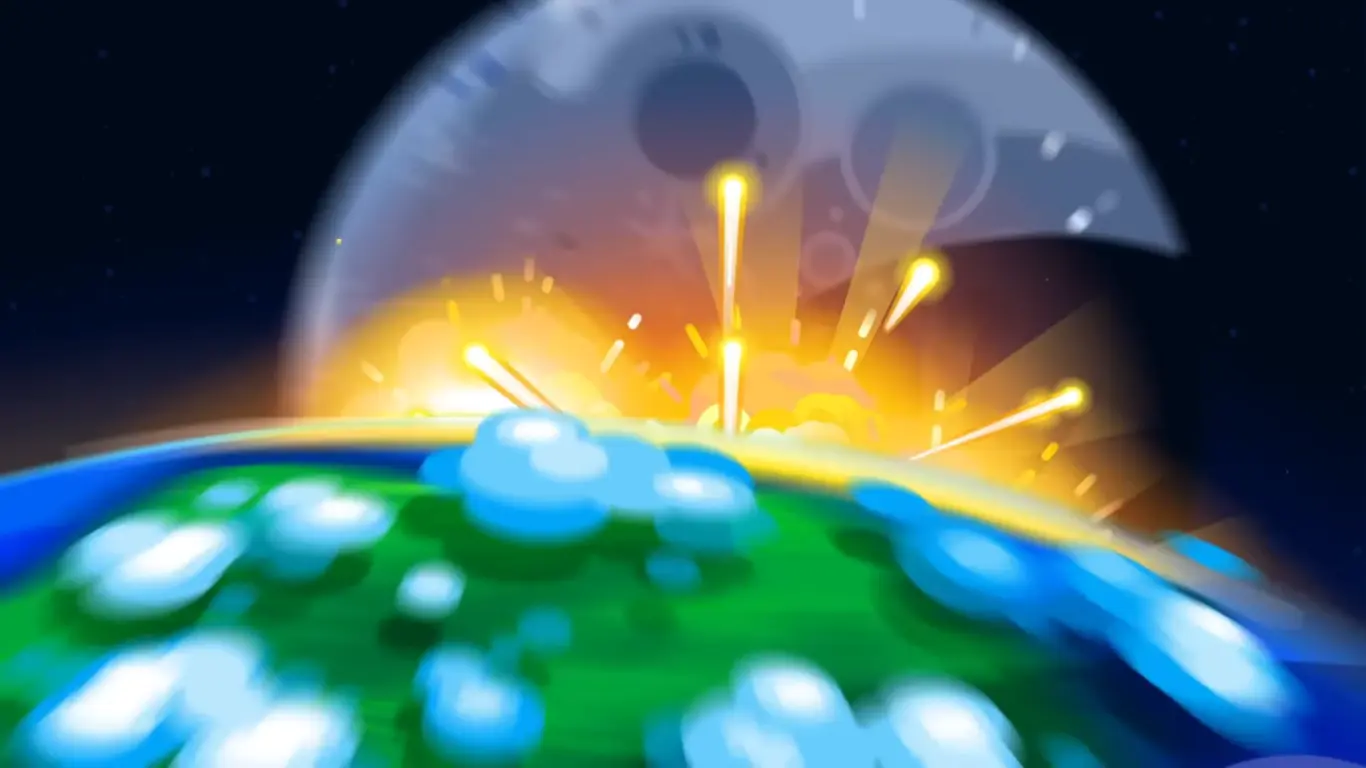
Moon Crashes into Earth
We are addressing a long-standing and significant scientific query today: what would happen if the Moon Crashes into Earth? You probably don’t realize how strange and fascinating it is. Let’s start with the fundamentals: why isn’t the moon already headed our way?
We are aware that everything, including the moon, is drawn to Earth by its gravitational force. However, it manages to remain upright, seemingly suspended by an opposing force. However, there is no additional force opposing gravity; instead, a sideways motion known as an orbit is the key to staying awake. Every day, we see orbits; when we toss a ball, it creates a very small orbit. The ball’s eventual impact with the ground is the only distinction between its orbit and the moons’.
In essence, speed is the cause. The ball would curve around the globe and return to you if you could throw it quickly enough. It could orbit indefinitely if there was no air to slow it down. And that’s exactly what the moon does—it falls quickly and sideways around the earth without any air to slow it down. traveling at 3600 km/h around the planet every 27 days. Therefore, it would violate every law of physics that we have time to describe if the moon were to just halt in its orbit and fall to Earth. How then do we smash it into the ground?
An object’s orbit can be altered by altering its speed, which modifies the direction that gravity takes it. However, even a slight alteration necessitates a tremendous amount of force, which explains why all of the solar system’s major objects have remained so stable up to this point.
Table of Contents
Science claims that the moon is so large and enormous that it would hardly move if billions of rocket motors were fired all over its surface. It appears that the moon will fall only by sorcery. We will thus employ a magical spell that causes the moon to slow down to such an extent that it alters its orbit and spirals in the direction of Earth. It will take precisely a year for the moon to reach Earth in order to maximize the experience.
Are you ready? 3, 2, 1…Magic – Moon Crashes into Earth
Now in the first month (~384000 km to ~200000km)
Nothing much changes within the first several days. Scientists are perplexed when the moon becomes slightly brighter, but the rest of us don’t detect any changes. The tides are the sole obvious impact of the moon on Earth. The earth pulls on the moon, which is why tides exist. The earth is pulled back by the moon’s gravity. varied sections of the globe experience slightly varied pulls because gravity weakens with distance. This results in the planet, particularly the oceans, expanding when the moon is above and slightly contracting on its sides when it is not.
Moon Crashes into Earth
The moon’s influence causes the oceans’ water level to rise and fall by around half a meter twice a day as the earth spins beneath it every day. However, high tide rises daily as the moon approaches closer. The moon is initially hardly noticeable, but in just one month, it has traveled half the distance to Earth, and ocean tides have increased to four meters. Coastal cities are inundated by waves every day when high tide arrives. And the vista is endless. Every day, more populated land and another city are submerged under salty sea as the moon approaches and the tides rise.
Moon Crashes into Earth – The Second Month (~200000 km to ~133ooo km).
By the end of the second month, the moon has traveled two-thirds of the way to Earth, and as the tides climb over ton meters, the world’s infrastructure is collapsing. Up to a billion individuals who lived close to the coast were displaced. Shipping cuts in half as ports become unusable. Delivery of goods, including less exciting items like food, will also be slowed down. Globle communications become disorganized.
The ocean-crossing cables that carry 95% of the internet are mostly water-based, but also have land-based endpoints. Living inland also does not ensure safety because tidal bores cause rivers to flow backward, contaminating surface and groundwater supplies with salt water. As oil refineries close to the coast are shut down, gas shortages ensue. Strict rationing will start, and nations are left with the goods they had on hand. When the water returns, survivors seek shelter in the high-rises, while anarchy reigns in the cities during the low-tide scavenging hours.
Moon Crashes into Earth – The Third Month (~133000 km to ~100000 km).
After three months, the moon is close enough to interfere with satellites used for navigation and communication. The closer it approaches, the more distorted our satellites’ orbits become, even though it is far too far away for its gravity to pose a serious threat. Satellites lose control when their orbital correction fuel runs out.
Moon Crashes into Earth
The Month Four and Five (~100000 km to ~ 60000 km).
The tides on Earth are rising quickly to a height of roughly 30 meters, and in a few short weeks, they will reach 100 meters. At high tide, walls of water submerge homes, businesses, and skyscrapers, while at low tide, the ocean recedes hundreds of kilometers, revealing the continental shelf like huge deserts. And the apocalypse has now completed its warm-up performance after nearly five months. The tides have peaked because the oceans are just three kilometers deep on average. As of right now, the ocean’s water may flow and absorb the majority of the moon’s gravitational pull, but the earth is actually feeling the squeeze of the moon’s constant approach.
Moon Crashes into Earth
These are more like tides of rock than tides of water. The weight of quintillions of tons of water sloshing on and off the tectonic plates, along with the planet’s compressing, causes tremendous stresses below and starts to produce earthquakes of ever-increasing magnitude and severity. Similar to a youngster jumping on their bed till it breaks, it is impossible to predict the severity or location of these earthquakes.
On other planets and moons, strong tidal pressures cause volcanism. Large, climate-changing eruptions occur in Chile, New Zealand, Yellowstone, and other places when the Earth is compressed, upsetting the magma stores within the crust. The moon, which is still no larger than a tiny cloud in the sky, is quietly observing from above. It is brilliant enough to light up the night sky like twilight within 75,000 kilometers of Earth.
The Month Six and Seven (~60000 km to ~40000 km)
After six months, the moon is moving into the area where geosynchronous satellites used to orbit the earth every twenty-four hours. Only half of the earth can see it, and it seems to float motionless in the sky, going through a complete set of phases every day. The tides appear to freeze in place while the moon is motionless above the earth; half of the world is flooded, and the other half has its water presumably returned to the sea, as though the earth is holding its breath in anticipation of the worst. You may worry if the moon’s gravity would overwhelm Earth as it descends farther, lifting you up and putting an end to your suffering.
Moon Crashes into Earth
Thankfully not. The surface gravity of the earth is around six times greater than that of the moons. Therefore, you would remain on the ground even if the moon were directly overhead. On the moon, however, things are different. Because the moon’s near side is more heavily impacted by Earth’s gravity, it begins to stretch forward toward the earth over the course of the following few months, like an egg, which causes deep moonquakes as the lunar rock flexes and changes shape. This “squish,” which is currently hardly perceptible, will expand to hundreds of kilometers in a few months.
The Month Eight to Eleven (~40000 km to ~10000 km).
Now that the end of the world has come, we can sum up the months before to the crush by saying that everyone who fled had a terrible time. Because the moon now circles the globe more quickly than it rotates, the tides rushing over the planet slow down and eventually turn around. There will be a lot of earthquakes and volcanism on the world. Massive volumes of volcanic aerosols, which are sufficiently bright to reflect sunlight back into space, ascend high into the stratosphere.
Moon Crashes into Earth
Daily eclipses regularly reduce the rust-red light that does get it through. As a result, the world cools quickly, and even hardy plants are killed by summer snows and acid rain. Civilization is running out of time. While an egg-shaped moon continues to approach, billions have died. Let’s prepare for the big show.
Month Twelfth, The Final Month (~10000 km remaining).
Lastly, the moon reaches its Roche limit at the conclusion of the year. At that time, the moon’s gravitational pull from Earth is greater than the moon’s own. When the moon reaches a distance of 10,000 kilometers, everything on its surface begins to fall toward Earth. By then, the entire moon has crumbled into rubble, spreading itself into a gigantic ring system around the planet. Thankfully, the moon’s disintegration has put an end to Earth’s suffering. The general apocalyptic character of things stops when there is no moon. The last time the land flows, the oceans recede.
Moon Crashes into Earth
As meteor showers of moon dust fill the sky, any survivors are rewarded to a view of the enormous arches that span the sky, shimmering in the sunlight and illuminating the night sky more brilliantly than any full moon could.
The peace may not last long, but it’s difficult to predict what will happen next. Friction heats the atmosphere when too much moon dust falls, potentially boiling the oceans. If not, a period of runaway cooling might start, freezing most of the earth’s surface solid, as the massive shadows cast by the rings, along with all the volcanic and meteoric aerosols, block even more sunlight.
Either way, people will eventually come out of bunkers, mountain tops, and submarines once more. Before recreating society, they won’t have much fun, and their success isn’t assured. However, they will at least attempt to do so with lovely rings in the sky.
Moon Crashes into Earth